


Selecting the right towel manufacturer determines the success of any towel business. Buyers often face challenges such as unstable towel GSM, fading colors, or late shipments. Common mistakes include insufficient research, unclear communication with the towel supplier, and treating the process as a single transaction instead of a partnership.
Hede Textile’s thirty years of experience as a top towel manufacturer highlight the value of reliability, customization, and strict quality control. Importers and wholesalers who ask the right questions can avoid costly errors and secure the best towel manufacturer for their market needs.
Key Takeaways
Choosing the right towel manufacturer is crucial for business success. Research thoroughly to avoid common mistakes.
Ask about yarn quality and sourcing. High-quality yarn ensures soft, durable, and absorbent towels.
Request certifications and test reports. These documents confirm that towels meet safety and quality standards.
Understand the manufacturer’s quality control processes. A reliable supplier conducts multiple inspections to ensure consistent quality.
Inquire about customization options. Tailored towels can enhance brand identity and meet specific customer needs.
Evaluate the supplier’s sample policy. Testing samples helps confirm quality before placing large orders.
Clarify pricing structures and payment terms. Transparent pricing helps avoid hidden costs and supports better budgeting.
Check the manufacturer’s reputation and client testimonials. A trusted supplier has a proven track record of quality and reliability.
Towel Manufacturer Materials & Standards
Yarn Selection for Towels
A towel manufacturer must prioritize the quality of materials at the very start of production. The yarn selection process determines the softness, absorbency, and durability of towels. Leading factories, such as Hede Textile, source 100% cotton yarn for most towel products, with options for bamboo, modal, or recycled blends. Strict checks on humidity and tensile strength ensure the yarn meets high quality standards. Buyers should request details about yarn sourcing and batch traceability. Consistent yarn quality leads to uniform towel texture and color, reducing the risk of defects in bulk orders.
Tip: Ask the towel manufacturer for a digital record of yarn batches and specifications. This helps verify the quality of towels and supports long-term consistency.
-05-1-1024x538.jpg)
Material Certifications
Certifications play a critical role in verifying the safety and quality of towels. A reputable towel manufacturer will comply with both national and international quality standards. The most relevant certifications for towel products include:
Standard | Description |
|---|---|
GB/T 22864-2020 | Chinese standard for woven towel products, focusing on safety and quality. |
National technical specification for textile safety, including pH and color fastness. | |
ASTM D5433-2012 | Performance specification for towels in public and household use. |
BS EN14697-2005 | Specification and test methods for textile towels. |
Buyers should request copies of certifications and test reports from the towel manufacturer. These documents confirm compliance with safety regulations and quality standards. Certifications such as GB 18401 address formaldehyde content and color fastness, while ASTM and BS EN standards ensure performance in various markets. Hede Textile maintains full documentation for every export, supporting transparency and trust.
Durability & Absorbency
The durability and absorbency of towels depend on the quality of materials and manufacturing standards. Industry benchmarks use GSM (grams per square meter) to measure towel weight and performance. The following table outlines typical GSM ranges and their applications:
Description | Use Cases | |
|---|---|---|
Low GSM (<400) | Thin, lightweight towels with basic durability. | Hand towels, kitchen towels, travel towels |
Medium GSM (400-600) | Balanced absorbency and drying speed. | Household bath towels |
High GSM (600-900) | Maximum absorbency and plush feel. | Luxury bath towels, hotel towels |
A towel manufacturer should provide clear specifications for GSM, absorbency rate, and durability. Hede Textile tests every batch for water absorption time, color fastness, and fiber shedding, ensuring the quality of towels meets international standards. Buyers can request sample towels and test reports to verify these properties before placing bulk orders.
Note: Always confirm the towel manufacturer’s defect rate and inspection process. Reliable factories maintain defect rates below 1.5%, supporting consistent quality standards.
Towel Quality Control Processes
A towel manufacturer must implement a robust quality control system to ensure every towel meets the highest standards. Quality control begins at the earliest production stages and continues through final inspection. Buyers should understand the quality control process to minimize risks and guarantee consistent results in bulk towel orders.
Multi-Stage Inspection
A comprehensive quality control process involves multiple inspection points. Each stage targets specific aspects of towel quality, from raw material checks to finished product evaluation. Leading factories, such as Hede Textile, use a multi-level inspection system that covers:
Raw material verification for yarn strength and moisture.
In-process monitoring of weaving tension and loop density.
Post-weaving inspection for defects, pile direction, and uniformity.
Cutting and sewing audits for accurate dimensions and seam quality.
Final inspection for absorbency, colorfastness, and appearance.
Industry standards guide these inspections. The table below summarizes key benchmarks:
Standard | Description |
|---|---|
Oeko-Tex | Evaluates towels for harmful chemicals and ensures compliance with safety regulations. |
ASTM D4772 – 14 | Tests surface water absorption of terry fabric. |
ASTM D5433 – 12 | Covers performance specifications, including breaking strength and colorfastness. |
GOTS | Certifies towels with a minimum of 70% organic fibers and annual inspections. |
A towel manufacturer that follows these standards demonstrates a commitment to quality and safety.
Third-Party Testing
Independent testing adds another layer of assurance to the quality control process. Many buyers request third-party audits from organizations such as SGS, BV, or Intertek. These audits verify that towels meet international standards for absorbency, colorfastness, and chemical safety. Hede Textile supports third-party inspections and provides full documentation for every shipment. This transparency builds trust and helps buyers avoid disputes over towel quality.
Note: Third-party testing is especially important for buyers in regulated markets or those with strict brand requirements.
Defect Rate Management
Managing defect rates is a critical part of any quality control system. Leading towel manufacturers track and analyze defects at every stage. Common issues include stains, shearing, linting, bowing, uneven dyeing, and holes. In the industry, initial defect rates in terry towel production can reach 0.7%. With corrective actions, top factories reduce this rate to as low as 0.3%. Hede Textile maintains a defect rate below 1.5%, reflecting a strong commitment to quality.
Typical defect breakdown in towel production:
Stains: 19.7%
Shearing: 4.5%
Linting: 1.9%
Bowing: 0.5%
Uneven dyeing: 0.3%
Holes: 7.2%
Buyers should always ask the towel manufacturer for recent defect rate statistics and details on corrective measures. A transparent approach to defect management ensures that only high-quality towels reach the market.
Towel Customization Options
Customization plays a vital role in helping brands stand out in the competitive towel market. Buyers in hospitality, retail, and promotional sectors increasingly seek unique towel customization options to reinforce their brand identity and meet customer expectations. A towel manufacturer that offers a wide range of customization techniques enables clients to create customized towels that reflect their brand values and appeal to target audiences.
Embroidery & Branding
Embroidery remains one of the most popular methods for branding towels. This technique uses stitched logos or text to deliver a premium, long-lasting finish. Hotels, spas, and corporate gifting programs often request embroidered towels because the result looks elegant and withstands repeated washing. Hede Textile operates advanced multi-head embroidery machines, allowing for intricate designs and consistent quality across large orders. The in-house design team works closely with clients to turn digital artwork into production-ready files, ensuring every towel meets branding requirements.
Tip: Embroidered logos add perceived value and durability, making them ideal for high-end hospitality and retail environments.
Jacquard & Printing
Jacquard weaving and printing techniques offer additional ways to customize towels. Jacquard weaving integrates logos or patterns directly into the towel during production, creating a textured, high-quality result that does not fade over time. This method suits luxury brands and retail products seeking a sophisticated look. Printing options, such as screen printing, sublimation, and heat transfer, provide vibrant, full-color designs for events, sports teams, and promotional campaigns. Each technique serves different branding needs:
Technique | Description | Ideal For |
|---|---|---|
Embroidery | Stitched logos or text for a premium finish | Hotels, spas, corporate gifting |
Screen Printing | Bold designs using ink pressed onto fabric | Events, promotional giveaways |
Sublimation Printing | Full-color, edge-to-edge designs on polyester | Beach towels, sports teams, lifestyle |
Jacquard Weaving | Logo or pattern woven into the towel | High-end branding, retail, luxury |
Heat Transfer Printing | Heat-applied logos or images | Fitness centers, clubs, merchandise |
Patchwork/Labels | Custom patches or sewn-on tags | Fashion-forward branding, collaborations |
Tone-on-Tone Embossing | Subtle, textured branding with raised patterns | Elegant branding, minimalist aesthetics |
The growing demand for personalized towels reflects a broader trend in the market. Brands use customization to differentiate themselves, appeal to individual tastes, and enhance customer satisfaction.
Packaging Choices
Packaging serves as the final touchpoint for customized towels. A towel manufacturer with flexible packaging solutions helps brands reinforce their image and protect product quality during transit. Hede Textile offers a variety of packaging options, including eco-friendly bags, gift boxes, and compression packaging for bulk shipments. The packaging team ensures each towel arrives in perfect condition and aligns with the client’s branding strategy.
Note: Thoughtful packaging not only protects towels but also elevates the unboxing experience for end users.
A focus on quality at every stage of customization—from embroidery to packaging—ensures that towels meet both functional and branding goals. Buyers should always discuss their towel customization options with the manufacturer to achieve the best results.
Towel Supplier Sample Policy
Evaluating samples before placing a bulk order remains a critical step for any buyer. A reliable towel supplier understands that hands-on inspection of a towel’s texture, absorbency, and finishing helps prevent costly mistakes. This process allows buyers to confirm that the towel manufacturer can meet their expectations for quality and customization.
Standard & Custom Samples
Most towel suppliers offer both standard and custom sample options. Standard samples showcase the supplier’s existing towel range, including popular sizes, colors, and weaving styles. These samples help buyers assess the general quality and craftsmanship of the towels. Custom samples, on the other hand, reflect the buyer’s specific requirements—such as unique dimensions, GSM, or branding elements. A towel supplier with strong customization capabilities can quickly translate a client’s design into a tangible product.
Hede Textile, for example, provides both standard and custom towel samples. The company’s sample request process is straightforward, allowing buyers to evaluate the product before committing to a larger order. Not all suppliers offer free or refundable samples. Many require a nominal fee, often around $10, to cover production and shipping costs. This policy ensures that buyers receive genuine samples while maintaining transparency in the supplier relationship.
Sample Lead Time
Sample lead time varies significantly among towel suppliers. The timeline depends on the complexity of the towel and the supplier’s production schedule. The following table summarizes typical sample lead times from several manufacturers:
Manufacturer | Sample Type | Lead Time (Days) | Notes |
|---|---|---|---|
Airswimwear | Standard | 15-30 | Includes production and shipping time |
Airswimwear | Sampling | 7-10 | Timeline provided with quote |
Towelage | Custom Design | N/A | Includes design and shipping charges |
Towel Specialties | Custom Beach Towel | 90-100 | Includes pre-production sample time |
Buyers should always clarify the expected lead time with their towel supplier. Hede Textile typically delivers standard samples within two days and custom samples within five to seven days, which demonstrates a commitment to efficiency and customer satisfaction.
Sample Fee Refunds
Sample fees and refund policies differ across the towel supplier landscape. Some suppliers charge a nominal fee for samples, while others may refund this cost if the buyer proceeds with a bulk order. The industry does not guarantee free samples. Many towel suppliers use a fee-based approach to ensure serious inquiries and offset production expenses. Buyers should confirm the sample fee policy in advance and request written documentation regarding potential refunds.
Tip: Always ask the towel supplier if the sample fee can be deducted from the final invoice for bulk towel orders. This practice supports a transparent and mutually beneficial relationship.
A clear sample policy from the towel manufacturer builds trust and reduces risk for both parties. By understanding the options for standard and custom samples, expected lead times, and fee structures, buyers can make informed decisions and streamline the sourcing process for towels.
Towel Manufacturer Pricing Structure
A clear pricing structure helps buyers understand the true cost of towels and supports informed decision-making. Every towel manufacturer should provide transparent details about how prices are calculated, including all factors that affect the final cost. This approach allows buyers to compare offers from different towel suppliers and select the best option for their business.
Transparent Cost Breakdown
Buyers need to know what drives the pricing of towels. The main factors include tariffs, production costs, and shipping expenses. Each element plays a role in determining the final price a towel supplier offers. The following table outlines these key factors:
Factor | Description |
|---|---|
Tariffs | Taxes applied to imported goods that increase costs for importers, affecting retail prices. |
Production Costs | Expenses related to manufacturing towels, which directly influence pricing structures. |
Shipping Expenses | Costs incurred during the transportation of towels, impacting final pricing for consumers. |
A reputable towel manufacturer, such as Hede Textile, provides factory-direct pricing. This means buyers avoid extra charges from intermediaries and receive a straightforward cost breakdown. Transparent pricing supports better budgeting and reduces the risk of hidden fees.
Tip: Request a detailed quotation from the towel supplier that lists all cost components, including material, labor, packaging, and logistics.
Volume Discounts
Bulk orders often qualify for volume discounts, which can significantly lower the unit price of towels. Most towel suppliers offer tiered pricing based on order quantity. The table below shows common discount rates:
Quantity | Discount Rate |
|---|---|
5+ | 10% off |
10+ | 15% off |
Some towel suppliers, such as Towel Depot, provide a price breakdown from dozen to per piece price. Large volume purchases can reduce costs, with prices dropping to as low as $0.24 per towel. Buyers should always ask the towel manufacturer about available volume discounts and negotiate terms that fit their needs.
Volume discounts benefit buyers by:
Lowering per-unit costs.
Improving profit margins.
Supporting long-term partnerships with the towel supplier.
Payment Terms
Understanding payment terms is essential for smooth transactions with any towel manufacturer. Payment policies vary among towel suppliers, so buyers should clarify these details before placing an order. Common payment options include:
Bank transfer (T/T) for secure international transactions.
Letter of credit (L/C) for added protection in large orders.
PayPal or credit card for small sample orders.
Hede Textile offers flexible payment terms to accommodate different buyer requirements. Clear payment policies help prevent misunderstandings and support a reliable business relationship.
Note: Always confirm the towel supplier’s payment schedule, deposit requirements, and refund policies before finalizing any order.
A transparent approach to pricing and payment terms ensures buyers receive high-quality towels at fair prices. By discussing cost breakdowns, volume discounts, and payment options, buyers can build strong partnerships with their towel manufacturer and maintain effective quality control throughout the sourcing process.
Production Capacity & Lead Times
A towel manufacturer’s ability to deliver on time and at scale is a critical factor for any buyer. Understanding production capacity and lead times helps businesses plan inventory, manage promotions, and avoid costly stockouts. Buyers should always confirm that their supplier can handle both routine and urgent orders without compromising quality.
Daily Output
Production output reflects a factory’s efficiency and reliability. Leading manufacturers operate advanced weaving and finishing lines to maintain consistent daily output. For example, Hede Textile runs 24/7 operations with three shifts, producing up to 20 tons of finished towels each day. This includes approximately 10,000 bath towels, 30,000 hand towels, and 60,000 face towels. Such capacity ensures that even large or recurring orders can be fulfilled promptly. Buyers should request detailed output figures and ask how the manufacturer manages peak demand periods.
-17-4-1024x538.jpg)
Rush & Bulk Orders
Many businesses require fast turnaround for promotional events, seasonal sales, or unexpected surges in demand. A towel manufacturer with flexible scheduling and strong supply chain management can accommodate rush and bulk orders. Hede Textile’s workflow allows for urgent requests by maintaining sufficient raw material inventory and leveraging partnerships with local suppliers. The factory’s digital management system tracks each order from yarn preparation to final inspection, ensuring transparency and efficiency.
Buyers should inquire about the lead time for bulk orders and the process for expediting urgent shipments. Manufacturers often use AI scheduling tools to monitor production in real time. These systems identify bottlenecks and adjust timelines dynamically. If a sample approval is delayed, the AI can modify the cutting schedule and prioritize tasks, helping to keep shipment dates on track.
Delay Management
Delays can disrupt the entire supply chain, leading to missed delivery dates and dissatisfied customers. Effective towel manufacturers implement proactive delay management strategies. Common causes of delay include late sample approvals, which can postpone the planned cut date and compress the production schedule. This may require overtime or additional resources and can impact finishing quality.
Manufacturers address these risks by:
Closely monitoring sample approval timelines.
Using real-time scheduling tools to adjust production plans.
Allocating extra resources during peak periods.
Communicating promptly with buyers about any changes.
A transparent approach to delay management helps maintain trust and ensures that towels arrive as promised. Buyers should always ask for the manufacturer’s recent on-time delivery statistics and their contingency plans for handling unforeseen delays.
Tip: Consistent communication and digital tracking systems are essential for minimizing disruptions and ensuring reliable towel deliveries.
Towel Supplier References & Reputation
Verifying a towel supplier’s reputation is a crucial step in the sourcing process. Buyers who check references and review a supplier’s track record can avoid unexpected issues and build long-term partnerships. A reliable towel supplier demonstrates consistent quality, timely delivery, and strong customer relationships.
Industry Experience
Industry experience sets a towel supplier apart in a competitive market. Suppliers with decades of production history understand the nuances of towel manufacturing, from yarn selection to finishing techniques. They adapt to changing market trends and maintain stable supply chains. Hede Textile, for example, has over 30 years of experience as a towel manufacturer, exporting towels to Europe, North America, Japan, and the Middle East. This level of experience signals reliability and a deep understanding of international standards.
When evaluating a towel supplier, buyers should consider several key criteria:
Criteria | Description |
|---|---|
Quality of Towels | High-quality towels improve user satisfaction; look for premium materials and consistent craftsmanship. |
Pricing and Value | Assess overall value, including bulk discounts and added services, not just the initial price. |
Reliability and Timeliness | Confirm the supplier’s ability to meet deadlines and deliver as promised. |
Environmental Sustainability | Choose suppliers with eco-friendly practices, such as organic or bamboo towel options. |
A supplier’s longevity and export history often reflect their ability to meet these standards.
Client Testimonials
Client testimonials offer direct insight into a towel supplier’s performance. Positive feedback from established brands or repeat clients indicates trustworthiness and product consistency. Buyers should request references or testimonials from previous customers, especially those in similar industries. Many reputable suppliers maintain a portfolio of testimonials highlighting their strengths in quality, communication, and on-time delivery. Hede Textile, for instance, has built long-term partnerships with clients worldwide, many of whom have provided positive feedback on the company’s reliability and service.
Tip: Ask the towel supplier for contact information of existing clients willing to share their experiences. This step helps verify claims and builds confidence in the supplier’s capabilities.
Case Studies
Case studies provide concrete examples of how a towel supplier handles specific challenges. These real-world stories showcase the supplier’s problem-solving skills, adaptability, and commitment to customer satisfaction. Buyers should look for case studies that detail the supplier’s approach to quality control, customization, and logistics. For example, a towel manufacturer with a history of supporting urgent hotel openings or large-scale promotional events demonstrates flexibility and resourcefulness. Hede Textile’s export history includes successful collaborations with hospitality, healthcare, and retail clients, reflecting the company’s ability to deliver tailored solutions across diverse markets.
By reviewing industry experience, client testimonials, and case studies, buyers can make informed decisions and select a towel supplier that aligns with their business goals.
Shipping & Logistics for Towels
Efficient shipping and logistics play a vital role in the towel supply chain. Buyers must confirm that their towel manufacturer can handle shipping and delivery with precision and reliability. The process involves export support, packaging integrity, and delivery tracking, each contributing to a smooth transaction and customer satisfaction.
Export Support
Export support ensures that towels reach international markets without delays or compliance issues. A professional towel manufacturer provides comprehensive export services, including documentation, customs clearance, and consulting. Hede Textile’s logistics team manages all export paperwork and coordinates shipments from its facility near Tianjin Port, which shortens transit times and reduces costs. The following table outlines standard logistics and export support services offered by leading towel suppliers:
Service Type | Description |
|---|---|
Export of Terry Towels | Specializes in exporting premium-quality terry towels sourced from top manufacturers. |
Import-Export Consulting | Provides consulting services for businesses expanding internationally. |
Logistics & Shipping Coordination | Manages all aspects of international shipping, from booking vessels to customs documentation. |
Quality Control & Compliance | Ensures products meet international standards through thorough inspections. |
Packaging Solutions | Offers custom packaging to protect towels during transit. |
Buyers should request details about export support, including available Incoterms, documentation accuracy, and customs procedures. These services help prevent delays and ensure that towels arrive on schedule.
Packaging Integrity
Packaging integrity protects towels from damage during shipping and enhances brand presentation. A reliable towel manufacturer offers a range of packaging solutions, such as moisture-resistant bags, eco-friendly options, and custom gift boxes. Hede Textile inspects every carton for moisture, labeling, and physical condition before shipment. Proper packaging reduces the risk of contamination, tearing, or loss during transit. Buyers should specify packaging requirements and confirm that the manufacturer can meet destination market standards.
Tip: Custom packaging not only safeguards towels but also supports branding and retail readiness.
Delivery Tracking
Delivery tracking provides transparency and peace of mind throughout the shipping process. Leading towel manufacturers use digital systems to monitor shipments, offering real-time updates and tracking numbers. Hede Textile’s logistics team supplies clients with photos, tracking codes, and estimated arrival dates for every order. This approach allows buyers to anticipate delivery, manage inventory, and respond quickly to any issues. Reliable delivery tracking minimizes uncertainty and supports long-term business relationships.
Buyers should always confirm the towel manufacturer’s tracking capabilities and request regular updates during transit. Clear communication and digital tracking tools ensure that towels reach their destination safely and on time.
Towel Product Range & Availability
A towel manufacturer’s product range directly impacts a buyer’s ability to serve diverse markets. Assessing the types of towels offered, the balance between stock and custom orders, and the supplier’s market coverage helps buyers select the right partner for long-term growth.
Types of Towels Offered
Manufacturers typically provide a wide selection of towel types to meet the needs of hospitality, retail, and healthcare sectors. Each type serves a specific function and comes in standardized sizes. The following table summarizes the most common options available from leading suppliers:
Towel Type | Typical Size (inches) | Common Uses |
|---|---|---|
Washcloth | 12 x 12 to 13 x 13 | Used for washing the face and body; essential for personal hygiene routines. |
Hand Towel | 16 x 28 to 18 x 30 | Ideal for drying hands and face; usually placed near sinks for easy access. |
Bath Towel | 27 x 52 to 30 x 58 | Suitable for drying the body after bathing; standard size for everyday use. |
Bath Sheet | 35 x 60 to 40 x 70 | Larger than bath towels; offers extra coverage and a luxurious experience. |
Bath Mat | 20 x 30 to 24 x 36 | Placed on the bathroom floor to absorb water and prevent slipping. |
Pool Towel | 30 x 60 to 35 x 70 | Designed for pool or beach use; larger for full-body coverage and quick drying. |
Spa Towel | 36 x 72 or larger | Extra-large towels used in spa treatments; provides full-body wrap. |
Guest Towel | 14 x 21 to 16 x 30 | Compact towel placed in guest or powder rooms; ideal for drying hands quickly. |
Buyers should review the towel manufacturer’s catalog to confirm the availability of these essential products. A comprehensive range supports both standard and specialized requirements.
Stock vs. Custom Orders
A flexible towel manufacturer offers both stock and custom order options. Stock towels provide immediate solutions for buyers who need fast delivery or standard specifications. Custom orders allow for tailored dimensions, GSM, colors, and branding features. Hede Textile maintains inventory of popular towel types and supports custom production for unique client needs. This dual approach enables buyers to respond quickly to market changes while maintaining brand identity.
Tip: Buyers should clarify minimum order quantities and lead times for both stock and custom towels to optimize their supply chain planning.
Market Segments
Market coverage reflects a towel manufacturer’s ability to serve different industries. Leading suppliers, including Hede Textile, produce towels for hospitality, retail, healthcare, sports, and promotional use. Each segment demands specific qualities, such as high absorbency for hotels, durability for clinics, or vibrant designs for retail brands. Buyers benefit from working with manufacturers that understand these requirements and can adjust towel specifications accordingly.
Hospitality: Hotels, resorts, and spas require premium towels with consistent quality.
Retail: Supermarkets and department stores seek a mix of standard and custom towels for broad consumer appeal.
Healthcare: Clinics and hospitals prioritize hygiene, durability, and easy-care features.
Promotional: Event organizers and corporate clients need branded towels for giveaways and marketing campaigns.
A diverse product range and market expertise position the towel manufacturer as a reliable partner for buyers seeking growth across multiple channels.
Eco-Friendly Towels & Sustainability
Sustainable sourcing and production have become essential in the textile industry. Buyers now expect their towel manufacturer to offer eco-friendly options and transparent environmental practices. These requirements reflect both market demand and regulatory changes. Companies that prioritize sustainability can improve product quality, reduce environmental impact, and strengthen their brand reputation.
Organic & Recycled Materials
Organic cotton and recycled fibers represent the foundation of sustainable towels. Many towel manufacturers now source certified organic cotton, which uses fewer chemicals and less water during cultivation. Recycled yarns, including post-consumer cotton and bamboo blends, help reduce waste and conserve resources. Hede Textile offers towels made from 100% cotton, bamboo, modal, and recycled yarns, meeting diverse client needs. The factory tracks each yarn batch for quality and traceability, ensuring that every towel meets strict standards. Buyers should request documentation on fiber origin and certification to verify claims. Organic and recycled materials support both product safety and long-term durability.
Tip: Ask the towel manufacturer for test reports on absorbency and fiber shedding. These reports confirm the quality of eco-friendly towels.
Eco-Packaging
Packaging plays a critical role in sustainability. Leading towel manufacturers provide eco-friendly packaging options, such as biodegradable bags, recycled paper boxes, and compression packs that reduce shipping volume. Hede Textile has introduced biodegradable and recyclable packaging for many towel products. The packaging team inspects every shipment for moisture resistance and labeling accuracy. Buyers can specify packaging preferences to align with their brand’s sustainability goals. Eco-packaging not only protects towels during transit but also enhances the customer experience.
Packaging Type | Environmental Benefit | Common Use Cases |
|---|---|---|
Biodegradable Bags | Reduces landfill waste | Retail, e-commerce |
Recycled Paper Box | Conserves resources | Gift sets, hospitality |
Compression Packs | Lowers carbon footprint | Bulk shipments, wholesale |
Environmental Practices
Responsible towel manufacturers implement environmental practices throughout production. Water recycling, energy-efficient machinery, and waste reduction are now industry standards. Hede Textile works with dyeing partners that use advanced filtration systems and low-impact dyes. The factory collects and repurposes cotton waste, optimizing resource use. Regular audits and staff training ensure compliance with safety and environmental regulations. Buyers should ask about the manufacturer’s water treatment, energy use, and waste management policies. These practices contribute to consistent quality and support global sustainability goals.
Note: Environmental responsibility is not just a trend. It is a requirement for maintaining high quality and meeting international standards.
Industry Update:
Recent developments in the towel industry include the adoption of plant-based dyes, automation in weaving for reduced energy consumption, and innovative packaging solutions. These changes help manufacturers deliver higher quality towels while minimizing environmental impact. Buyers benefit from improved product safety and greater transparency.
Customer Service & Communication
Clear, responsive communication forms the backbone of any successful partnership with a towel supplier. Buyers depend on timely updates, transparent processes, and reliable customer service to ensure smooth transactions and effective quality control. A towel manufacturer that prioritizes customer service and support can help prevent misunderstandings, resolve issues quickly, and build long-term trust.
Response Times
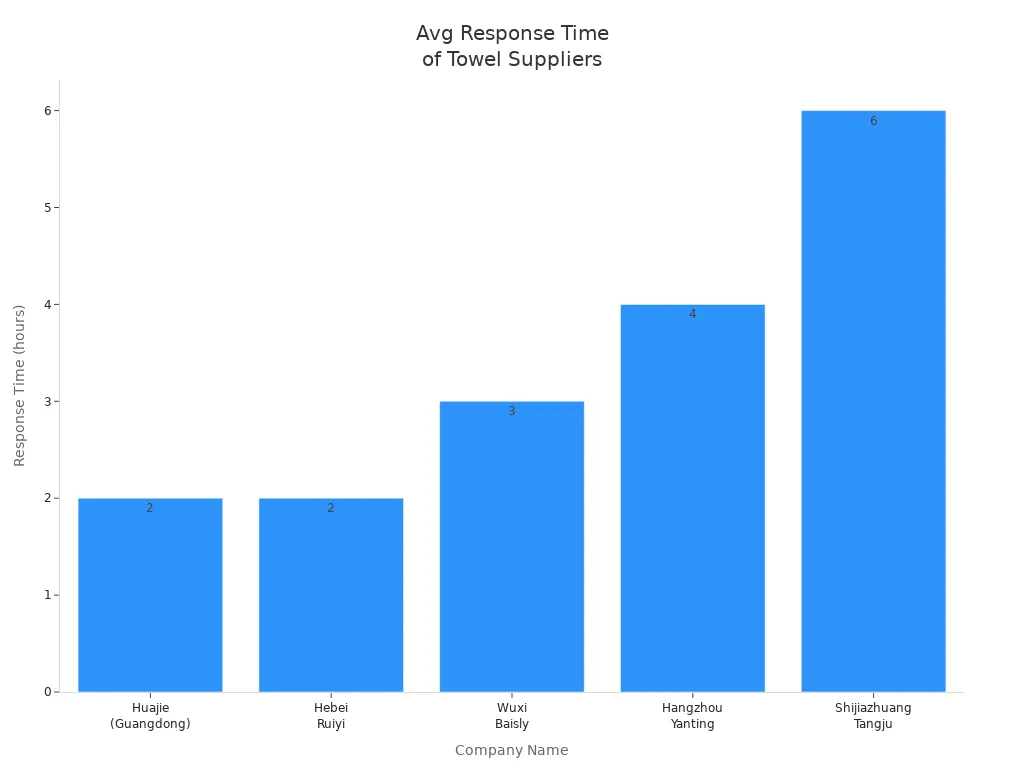
Fast response times set leading towel suppliers apart in a competitive market. Buyers often need urgent answers about towel specifications, order status, or quality control procedures. The average response time among top suppliers ranges from two to six hours, as shown in the table below:
Company Name | Response Time |
|---|---|
Huajie (Guangdong) Nonwovens Technology Co., Ltd. | ≤2h |
Hebei Ruiyi Trading Co., Ltd. | ≤2h |
Wuxi Baisly Textile Co., Ltd. | ≤3h |
Hangzhou Yanting Nonwoven Technology Co., Ltd. | ≤4h |
Shijiazhuang Tangju Trading Co., Ltd. | ≤6h |
Hede Textile stands out by offering 7×24-hour customer service. This continuous availability ensures that buyers receive prompt answers, regardless of time zone differences. Reliable response times help maintain efficient quality control and minimize delays in towel production or shipping.
Account Management
Dedicated account management enhances the buyer experience. A towel supplier that assigns a specific account manager provides a single point of contact for all inquiries, updates, and support needs. This approach streamlines communication and ensures that the supplier understands the buyer’s unique requirements for towels, customization, and quality control. Hede Textile assigns experienced account managers to each client, supporting seamless coordination from initial inquiry to final delivery.
Account managers play a key role in:
Coordinating sample approvals and production schedules
Providing regular updates on order progress
Addressing any quality control concerns promptly
This structure helps buyers navigate complex orders and maintain high standards for every towel shipment.
After-Sales Support
Comprehensive after-sales support is essential for maintaining product satisfaction and resolving any post-delivery issues. Leading towel manufacturers offer a range of customer service and support services, including:
Delivery follow-up
Customer service
Buyers should expect their towel supplier to follow up after delivery, confirm that towels meet agreed specifications, and address any quality control concerns. Hede Textile’s after-sales team remains available to assist with documentation, warranty claims, or replacement requests. This commitment to support strengthens long-term business relationships and ensures that buyers receive consistent value from their towel manufacturer.
Tip: Strong after-sales support reduces risk and helps buyers maintain high standards for every towel order.
Issue Resolution & Return Policy
A clear issue resolution and return policy protects buyers and ensures confidence when sourcing towels. Every towel manufacturer should provide transparent procedures for handling returns, replacements, warranty claims, and disputes. Buyers must clarify these processes before placing bulk orders to avoid misunderstandings and maintain quality standards.
Returns & Replacements
Buyers often encounter situations where towels do not meet agreed specifications or arrive with defects. A reliable towel manufacturer outlines specific steps for initiating a return or requesting a replacement. The process typically includes:
Submitting a written claim with supporting documentation, such as photos of the towel and proof of purchase.
Reviewing the claim against the manufacturer’s defect rate and quality standards.
Coordinating with the supplier to arrange for the return shipment or replacement towels.
Hede Textile maintains a transparent risk control system. The company documents every order with unique tracking codes, inspection reports, and packing lists. This approach allows buyers to reference exact batches and resolve issues efficiently. Buyers should always keep receipts and warranty cards to support their claims.
Tip: Request written confirmation of the towel manufacturer’s return policy, including timelines and conditions for replacements.
Warranty Terms
Warranty coverage varies among towel manufacturers. Buyers must understand the warranty terms to identify valid grounds for claims. Most warranties cover manufacturing defects, colorfastness, and absorbency for a specified period. The table below summarizes common warranty elements:
Warranty Element | Description |
|---|---|
Coverage Period | Duration of warranty after delivery |
Defect Coverage | Types of defects included (e.g., stitching, dye) |
Claim Procedure | Steps for submitting a warranty claim |
Documentation Needed | Proof of purchase, maintenance records |
Hede Textile provides detailed warranty documentation with each shipment. Buyers should review any denial letters for specific reasons and gather supporting evidence, such as maintenance records and visual documentation of damage. Understanding warranty terms helps buyers challenge denials and secure fair resolutions.
Dispute Handling
Disputes may arise over quality, delivery, or payment. A professional towel manufacturer offers a structured process for dispute resolution. Buyers should:
Review all relevant documentation, including invoices, inspection reports, and correspondence.
Gather evidence, such as photos and maintenance records, to support their position.
Communicate clearly with the supplier to identify the cause of the dispute.
Seek legal advice if necessary to navigate complex claims.
Hede Textile’s export specialists ensure documentation accuracy and maintain open communication throughout the order cycle. This transparency reduces the risk of disputes and supports long-term partnerships.
Note: Proactive communication and thorough documentation are essential for resolving issues with any towel manufacturer.
Buyers who clarify the supplier’s issue resolution and return policy can minimize risk and maintain consistent quality in every towel order.
Bulk Order Discounts & Incentives
Volume Pricing
Buyers seeking bulk orders for towels often prioritize cost efficiency. Leading towel suppliers structure their pricing to reward larger purchases. Volume pricing allows buyers to secure lower unit costs as order quantities increase. Many manufacturers offer tiered discounts, which can range from 5% to 15% off standard rates depending on the size of the bulk order. Some suppliers also introduce seasonal promotions or limited-time sales, providing additional opportunities to reduce expenses. Taking advantage of these offers helps buyers maximize their budget and improve profit margins.
Common volume pricing incentives:
Tiered discounts for increasing order quantities
Special rates for repeat bulk purchases
Seasonal promotions on selected towel products
Hede Textile demonstrates flexibility by accommodating both small and large bulk orders. This approach supports businesses at every stage of growth.
Partnership Benefits
Long-term partnerships with a towel supplier can unlock exclusive incentives beyond standard volume pricing. Manufacturers often provide priority production slots, faster sample development, and customized logistics support for loyal clients. These benefits streamline the procurement process and enhance supply chain reliability. Buyers who establish ongoing relationships with their towel manufacturer may also receive early access to new towel designs or eco-friendly packaging options.
Tip: Building a partnership with a reliable supplier can result in tailored solutions and consistent quality for all bulk towel orders.
Manufacturers value repeat business and often reward it with enhanced service levels. This commitment fosters trust and encourages collaboration on future projects.
Negotiation Tips
Effective negotiation strategies help buyers secure the best possible terms for bulk purchases. Several approaches can be used depending on the relationship and market conditions. The table below outlines key negotiation strategies and their applications:
Strategy Type | Description | Use Case |
|---|---|---|
Distributive Negotiation | Maximizes gain from fixed terms, typically price-focused | Direct cost-driven deals, such as purchasing raw materials |
Integrative Negotiation | Seeks mutual benefit, sharing information and aligning goals | Strategic supplier relationships or long-term partnerships |
Principled Negotiation | Focuses on fairness and collaboration, emphasizing interests over positions | Negotiating with critical suppliers where transparency is key |
Competitive Negotiation | Uses market benchmarking and multiple bids to drive better pricing | When several qualified suppliers are available to increase leverage |
Compromising Negotiation | Finds a middle ground with concessions from both sides | Mid-value contracts or renewals where time is limited |
Accommodating Negotiation | Prioritizes the relationship over achieving the best deal | Working with critical suppliers or during urgent procurement needs |
Buyers should prepare by researching market rates, clarifying their requirements, and maintaining open communication with the towel supplier. Combining these strategies can lead to favorable pricing and long-term value.
Bulk purchasing of towels offers significant advantages when buyers leverage volume pricing, partnership incentives, and effective negotiation. A transparent approach ensures both parties benefit and supports sustainable business growth.
Professional buyers gain a strategic advantage by asking these 12 questions when selecting a towel manufacturer. This checklist helps ensure reliable sourcing, consistent quality, and effective communication with any towel supplier. Prioritizing durability, customization, and transparent processes leads to better outcomes for every towel order. Hede Textile’s practices illustrate what buyers should expect from a trusted partner in the global towels market.