Choosing the right cotton towel manufacturer stands as a critical decision for importers who seek the best bath towels and aim to avoid common sourcing pitfalls. Buyers often encounter challenges such as inconsistent quality, delayed shipments, and overlooked certifications.
Challenge | Description |
|---|---|
Quality Assurance | Inconsistent GSM and fading colors can affect product quality. |
Supplier Reliability | Delayed shipments can disrupt business operations. |
Certification and Specifications | Overlooking essential certifications and fabric specifications can lead to problems. |
This bath towel guide explains how to choose the best towels, evaluate suppliers, and secure the best quality towels for every market. Mastering these steps leads to the best bath towel selections and reduced risk throughout the procurement process.
Key Takeaways
Choose a manufacturer with strong certifications like OEKO-TEX and GOTS to ensure product safety and quality.
Evaluate the GSM (grams per square meter) of towels; a range of 500-700 offers a good balance of absorbency and drying speed.
Request samples to assess towel quality, including texture, absorbency, and color stability before placing bulk orders.
Consider the manufacturer’s production capacity to ensure they can meet your order size and delivery timelines.
Look for manufacturers with a solid reputation and positive customer reviews to gauge reliability and service quality.
Prioritize sustainability practices; eco-friendly manufacturers enhance your brand’s reputation and appeal to conscious consumers.
Utilize customization options to differentiate your brand; tailor materials, sizes, and designs to meet market demands.
Maintain clear communication with your manufacturer to ensure all specifications and expectations are met throughout the process.
Cotton Towel Manufacturer Market Overview
The global cotton towel manufacturer market reached approximately USD 4.03 billion in 2023. Analysts expect growth to USD 7.16 billion by 2033, with a compound annual growth rate of 5.9%. This expansion reflects rising demand for soft, absorbent towels in hospitality, retail, and wellness sectors.
Material Standards
International buyers prioritize material standards when selecting a cotton towel manufacturer. These standards ensure product safety, durability, and compliance with global regulations.
Standard | Requirements |
|---|---|
Material Standards | No GMOs in cotton seeds, strict limits on pesticide and synthetic fertilizer use |
Processing Standards | No chlorine bleach, formaldehyde, or heavy metals in dyes, effluent treatment, restricted list of chemicals |
Cotton Types
Manufacturers use several cotton varieties to produce towels. Egyptian cotton and 100% Egyptian cotton offer long-staple fibers, resulting in towels that feel soft and remain absorbent after repeated use. Turkish cotton towels are prized for their plush texture and quick-drying properties. Pima cotton provides a balance of strength and softness, making it suitable for premium towel lines.
Long-staple cotton fibers, such as those found in Turkish cotton and Egyptian cotton, enhance towel longevity.
Two-ply yarns increase durability and resistance to wear.
Combed cotton delivers a smooth texture and maintains durability.
GSM and Absorbency
GSM (grams per square meter) measures towel density and weight. Most high-quality towels feature a GSM between 500 and 700, which balances absorbency and drying speed. Towels with higher GSM values feel more luxurious and last longer, while mid-range GSM ensures efficient moisture wicking.
Key Features | Impact on Durability and Performance | |
|---|---|---|
Long-staple Cotton | Stronger fibers, less prone to breaking | Enhances longevity and absorbency |
Two-ply Yarn | Two strands twisted together | Increases durability and resistance to wear |
High GSM (600+) | Quality and density | Better absorbency and longevity |
Combed Cotton | Smooth texture, reduces exposed ends | Improves softness and durability |
Double-stitched Hems | Reinforces edges | Extends towel lifespan |
Weaving Methods
Manufacturers employ several weaving techniques to create towels with distinct textures and performance characteristics.
Description | |
|---|---|
Plain weave base with terry pile | Most common method used for towels |
Jacquard weave | Creates decorative patterns and logos |
Dobby weave | Produces textured borders or checks |
Terry, Jacquard, Velour
Terry towels use looped yarns for high absorbency, making them ideal for bath and spa use. Jacquard towels feature intricate woven designs, suitable for branding and luxury markets. Velour towels have a sheared surface, offering a soft, plush feel for premium applications.
Single loop construction suits lightweight towels.
Double loop construction adds volume and absorbency.
Jacquard towels require gentle care; patterns may soften over time.
Plain weave towels resist snagging and suit heavy use.
Dyeing and Color Fastness
Color quality and stability remain essential for international buyers. Leading manufacturers use reactive dyes, which provide excellent wash fastness and UV resistance. Industry standards rate wash fastness at 4-5 and light fastness at 6, ensuring towels retain vibrant colors after repeated laundering.
Standard Type | Rating | Description |
|---|---|---|
Wash Fastness | 4-5 | Good resistance to washing per AATCC standards |
Light Fastness | 6 | Excellent resistance to sunlight fading per AATCC |
Reactive dyeing also supports eco-friendly production, reducing harmful waste. Hede Textile’s partnership with advanced dyeing mills ensures consistent color performance and compliance with environmental standards.
Note: Understanding GSM, cotton types, and weaving methods helps buyers evaluate towel quality and price. Hede Textile’s expertise in weaving precision, dyeing stability, and export reliability positions it as a trusted partner for global importers seeking consistent, high-quality towels.
Key Criteria for Selecting a Cotton Towel Manufacturer
Certifications and Compliance
International buyers rely on certifications to verify the safety, quality, and ethical standards of towels. A reputable cotton towel manufacturer provides documentation that meets global requirements. Certifications such as OEKO-TEX Standard 100, GOTS, ISO 9001, and BSCI or SEDEX confirm that towels are free from harmful substances, produced with organic integrity, and manufactured under ethical labor conditions.
Certification | Description |
|---|---|
OEKO-TEX® Standard 100 | Ensures textiles are free from harmful substances |
GOTS (Global Organic Textile Standard) | Required for organic cotton products |
ISO 9001 | Validates robust quality management systems |
BSCI or SEDEX | Social compliance for ethical labor practices |
Hede Textile maintains strict compliance with these standards, supporting buyers who demand genuine certified Egyptian cotton, organic materials, and safe production. These certifications help importers avoid regulatory issues and build trust with end consumers. For premium products such as 100% Egyptian cotton and Turkish cotton towels, certification guarantees authenticity and quality.
Tip: Always request certification documents before confirming an order. This step protects your brand and ensures the best quality towels reach your market.
Production Capacity
Production capacity determines whether a cotton towel manufacturer can fulfill large or urgent orders without compromising quality. Leading factories in China, Turkey, Egypt, and India operate advanced machinery and efficient supply chains to deliver consistent output. Hede Textile stands out with a daily capacity of 20 tons, including 10,000 bath towels, 30,000 hand towels, and 60,000 face towels. This scale supports both bulk and small-batch orders, offering flexibility for seasonal demand or promotional campaigns.
Country | Production Capacity Insights |
|---|---|
China | Largest global capacity with advanced machinery and efficient supply chains. |
Vietnam | Rapidly developing industry focusing on quality and export expansion. |
India | Emerging player with high-quality cotton production, especially from Indian and Egyptian cotton. |
Turkey | Known for premium Turkish cotton towels, emphasizing softness and durability. |
Egypt | Recognized for luxury Egyptian cotton towels, valued for softness and absorbency. |
Pakistan | Significant player with cost-effective production and high-quality cotton products. |
Manufacturers demonstrate scalability through rapid workforce expansion, custom skills assessment, and efficient recruitment. Hede Textile’s 24/7 operation and multi-stage quality control system ensure timely delivery and consistent standards. Buyers seeking the best bath towel or soft, absorbent towels benefit from a supplier that can adapt to urgent requests and maintain high output.
Quick hiring and training programs support large orders.
Structured production workflow reduces delays.
Flexible order quantities accommodate both bulk and small runs.
Sustainability Practices
Sustainability has become a decisive factor for buyers and consumers. Reputable cotton towel manufacturers adopt eco-friendly practices, including water recycling, energy optimization, and responsible waste management. Certifications such as Fair Trade, GOTS, and OEKO-TEX Standard 100 validate these efforts and assure buyers of ethical production.
Certification | Description |
|---|---|
Fair Trade Certified | Ensures fair wages, safe working conditions, and respect for workers. |
GOTS | Covers the entire production process from farming to manufacturing, ensuring organic integrity and ethical production. |
OEKO-TEX Standard 100 | Confirms the final product is free from harmful chemicals and safe for consumer use. |
Fair trade standards prohibit harmful chemicals.
Practices prevent water contamination.
Good waste management is required.
Manufacturers like Hede Textile integrate artisan craftsmanship and small-batch production to support sustainability. This approach ensures high-quality towels, respects workers, and protects the environment. Sustainability certifications such as BCI, OEKO-TEX, and GOTS empower buyers to make eco-conscious choices and enhance consumer trust. The growing preference for organic and sustainably sourced towels reflects a shift toward responsible purchasing.
Note: Sustainability practices not only improve product safety but also strengthen your brand’s reputation in the global market.
Customization Options
A top cotton towel manufacturer recognizes that customization drives brand differentiation and market success. Buyers expect more than standard products; they seek towels tailored to their specifications, audience, and branding goals. Hede Textile excels in delivering a wide range of customization options, supporting both established brands and emerging businesses.
Manufacturers typically offer customization in the following areas:
Material selection: cotton, terrycloth, bamboo, microfiber, linen
Towel types: bath towels, beach towels, baby towels, hair towels, kitchen towels, sport towels, car detailing towels, pet cleaning products, face towels
Size and shape adjustments: custom dimensions for unique applications
Cut and sew services: precise tailoring for specific requirements
Embellishments: hanging loops, snap buttons, Velcro straps, ribbons, tags, grommets with carabiners, pockets with zippers
Branding elements: logo embroidery, woven labels, custom jacquard patterns, all-over sublimation printing, screen printing
Packaging: personalized bags, boxes, ribbons, eco-friendly packaging solutions
Hede Textile’s advanced embroidery department utilizes computerized multi-head machines to produce intricate logos and decorative patterns. The in-house design team collaborates directly with clients, transforming sketches or digital mockups into production-ready files. This workflow enables rapid sample development, often within five to seven days.
Note: Customization extends beyond appearance. Buyers can specify absorbency levels, GSM, color palettes, and finishing techniques to match market preferences. Hede Textile maintains a digital database of color cards and design templates, ensuring consistency across repeat orders.
Manufacturers accommodate unique branding and design requests through several strategies:
Strategy | Description |
|---|---|
Create guidelines that allow for local adaptations while maintaining core brand identity. | |
Local empowerment | Give local teams the authority to modify branding elements to better connect with their audience. |
Market research | Conduct thorough research to understand local preferences and cultural nuances. |
Flexible brand framework | Develop a brand structure that can adjust to local market demands while aligning with the brand’s core values. |
Hede Textile’s customization process includes:
Direct consultation to clarify design intent and market needs
Sample production for approval before bulk manufacturing
Multi-stage inspection to verify color, texture, and logo accuracy
Transparent communication with photo and video updates throughout production
Clients benefit from flexible order quantities, allowing for small-batch promotional runs or large-scale retail launches. The factory’s experience in export logistics ensures that customized towels arrive safely and punctually, with packaging tailored to destination market requirements.
Tip: Buyers should request physical samples and review digital mockups before confirming bulk orders. This step guarantees that every detail—from logo placement to packaging—meets expectations and strengthens brand impact.
A cotton towel manufacturer with robust customization capabilities, such as Hede Textile, empowers importers to create products that resonate with their target audience and stand out in competitive markets.
Comparing Manufacturer Reputation and Reliability
Industry Experience
Industry experience stands as a cornerstone when evaluating a cotton towel manufacturer. Companies with decades of expertise demonstrate mastery in weaving, dyeing, and finishing techniques. They understand the nuances of producing towels that meet international standards for softness, durability, and absorbent performance. Hede Textile, for example, brings over 30 years of continuous operation, serving clients in Europe, North America, and Asia. This longevity signals stability and a proven ability to adapt to changing market demands. Experienced manufacturers often invest in advanced machinery and skilled technicians, ensuring consistent quality across every batch of towels.
A manufacturer’s reputation grows through years of reliable service, innovation, and successful export records. Buyers should prioritize suppliers with a documented history of fulfilling large orders, managing complex customizations, and maintaining strict quality control. The following table outlines key metrics used to evaluate reputation in the towel industry:
Metric | Description |
|---|---|
Customer Reviews | Indicate product quality and customer satisfaction, reflecting the manufacturer’s reliability. |
Timely Deliveries | Essential for maintaining customer satisfaction and avoiding delays in product availability. |
Ethical Practices | Ensures sustainable production and fair treatment of workers, enhancing brand reputation. |
Flexibility | Ability to customize products to meet specific business needs, indicating a responsive manufacturer. |
Supply Capacity | Manufacturer’s ability to scale production to meet demand, preventing stock issues. |
Customer Service | Quality of communication and support provided, crucial for addressing concerns and maintaining trust. |
Customer Reviews
Customer reviews provide valuable insights into the performance of a cotton towel manufacturer. They reveal real-world experiences with product quality, delivery reliability, and customer service. Buyers often rely on these reviews to gauge the manufacturer’s ability to deliver soft, absorbent towels that meet expectations. Positive feedback highlights strengths such as prompt communication, accurate order fulfillment, and consistent towel quality. Negative reviews may point to issues with shipment delays or product discrepancies.
Customer reviews provide insights into the quality of cotton towels.
They reflect the reliability of the supplier.
Overall customer satisfaction is gauged through reviews.
Positive reviews suggest good customer service and reliability.
Negative reviews can indicate potential issues with the supplier.
Manufacturers with a strong reputation often showcase testimonials from long-term clients. Hede Textile, for instance, receives praise for its responsive support and attention to detail in customization. Importers should review feedback from multiple sources, including trade platforms and direct references, to form a balanced view of supplier reliability.
Delivery Records
Delivery records play a critical role in the selection process. Timely shipments ensure that towels reach their destination without delay, supporting business continuity and customer satisfaction. Leading manufacturers maintain high on-time delivery rates, reflecting efficient production planning and robust logistics networks. Hede Textile’s proximity to major ports and its structured export workflow contribute to its punctual delivery performance.
The industry average for on-time delivery among top cotton towel manufacturers remains high, with many achieving rates above 90%. The chart below illustrates the delivery performance of several leading suppliers:
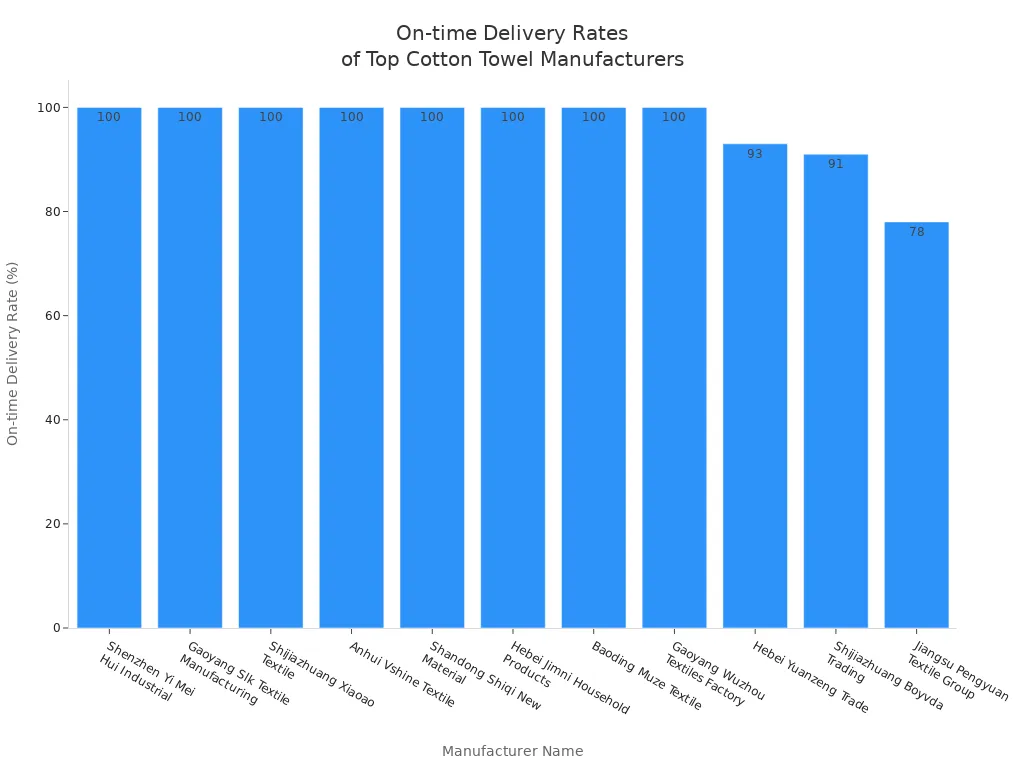
Manufacturers with consistent delivery records minimize the risk of stockouts and support reliable market launches. Importers should request shipment histories and verify delivery rates before finalizing partnerships. Reliable delivery, combined with strong customer reviews and deep industry experience, marks a manufacturer as a trustworthy source for absorbent, high-quality towels.
Quality Control Systems
A reputable cotton towel manufacturer invests in robust quality control systems to guarantee consistent product standards. These systems form the backbone of reliability, ensuring that every towel meets the expectations of international buyers. Hede Textile, for example, implements a comprehensive, multi-stage inspection process that covers every step from raw material selection to final shipment.
The most effective quality control systems in the towel industry include a combination of laboratory testing, in-process monitoring, and final product evaluation. The following table outlines key techniques used by leading manufacturers:
Quality Control Technique | Description |
|---|---|
Cotton Fiber Tests | Assess the quality and purity of cotton fibers, including length, strength, and moisture content. |
Fiber Content Analysis | Identifies the type and percentage of fibers to ensure compliance with material specifications. |
Cotton Yarn Tests | Evaluates yarn evenness, tensile strength, and twist level for uniformity and strength. |
Weaving Tests | Assesses the weave structure for desired density and stability. |
Terry Toweling Fabric Structure Tests | Evaluates loop density, height, and uniformity for optimal absorbency and softness. |
Dimensional Stability Test | Measures the towel’s ability to retain shape and size after washing. |
Tensile Strength Test | Measures resistance to tearing under tension, indicating durability. |
Durability Test | Simulates lifespan through repeated washing cycles to assess strength and appearance. |
Absorbency Test | Measures moisture retention capabilities, crucial for effective use. |
Terry Cloth Dyeing Tests | Assesses color fastness and quality of dye for vibrant, long-lasting colors. |
Terry Towel Color Testing | Employs precise measurement techniques for attributes like fabric weight and absorbency. |
A cotton towel manufacturer like Hede Textile follows a strict workflow to maintain quality at every stage:
Multiple inspections occur throughout the production cycle.
Technicians check for color consistency, fabric strength, size accuracy, and finish quality.
Performance tests evaluate color fastness, absorbency, and texture retention.
High-grade cotton yarn is sourced to ensure softness and durability.
Advanced technology supports precision in weaving and dyeing.
Note: Consistent quality control reduces the risk of defects and customer complaints. Buyers should always request details about a manufacturer’s inspection process and ask for sample test reports before placing large orders.
Hede Textile’s commitment to quality extends to digital tracking of each production batch. This system links every towel to its yarn source, loom, and dye lot, enabling rapid traceability and corrective action if needed. Third-party inspections, such as those by SGS or Intertek, are also supported for clients who require independent verification.
A strong quality control system not only protects the buyer’s brand but also builds long-term trust between importers and their chosen cotton towel manufacturer.
Evaluating Samples and Service
A thorough evaluation of samples and service helps buyers identify the right cotton towel manufacturer for their needs. This process ensures that every towel meets expectations for comfort, durability, and brand presentation.
Sample Quality
Texture and Finish
High-quality towel samples reveal much about a manufacturer’s standards. Buyers should examine the fiber content, preferring 100% cotton or blends with a high cotton percentage. Long-staple cotton fibers produce a soft, resilient towel that withstands repeated use. A plush terry or velour finish signals premium craftsmanship. The best samples feature a GSM between 400 and 600, offering a balance of absorbency and bulk. Reinforced stitching along the edges prevents fraying and extends the towel’s lifespan. After washing, a quality towel should feel even softer, maintaining its structure and comfort.
100% cotton or high-cotton blends
Long-staple fibers for softness and durability
Plush terry or velour finish
GSM of 400–600 for optimal absorbency
Tight, reinforced edges
Color Stability
Color stability remains a critical factor in sample evaluation. Buyers should look for rich, vibrant hues that resist fading or bleeding during washing. Advanced dyeing techniques, such as reactive dyeing, help maintain colorfastness and ensure the towel’s appearance remains consistent over time. Reliable manufacturers, including Hede Textile, conduct multiple lab dips and wash tests to confirm color stability before bulk production. Consistent color across samples and repeat orders demonstrates strong process control.
Tip: Always request wash test results and compare samples under different lighting conditions to verify color accuracy.
Customer Support
Effective customer support streamlines the sample evaluation process and reduces procurement risks. Leading manufacturers document evaluation criteria, align with the buyer’s decision team, and offer consultative guidance throughout the process.
Step | Description |
|---|---|
1 | Document the evaluation criteria |
2 | Gain agreement with the buying committee |
3 | Facilitate the buying process with expert advice |
This structured approach helps buyers optimize costs and improve supplier quality. Hede Textile assigns dedicated account managers who provide technical advice, regular updates, and transparent communication from sample request to final approval.
Communication Channels
Clear and responsive communication is essential for international buyers working with a cotton towel manufacturer. The most effective suppliers use multiple channels to ensure smooth collaboration:
Use clear, concise language in all correspondence.
Confirm understanding with written summaries after meetings.
Leverage video calls for complex design or technical discussions.
Prioritize quick response times and offer multilingual support.
Hede Textile supports communication through email, WhatsApp, WeChat, and video conferencing, ensuring buyers receive timely answers and production updates. This accessibility builds trust and accelerates the decision-making process.
Note: Reliable communication and attentive service set the foundation for long-term partnerships and successful towel sourcing.
Practical Steps to Finalize Your Choice
Request Samples
Buyers searching for where to buy bath towels should always begin by requesting samples from their shortlisted cotton towel manufacturer. This step allows direct evaluation of product quality and helps establish trust with the supplier. The following process ensures a thorough assessment:
Initiate contact with factory staff to build rapport and discuss their materials and production methods.
Request physical samples to examine the towel’s texture, absorbency, and stitch quality.
Confirm the manufacturer’s credibility by asking for certifications such as OEKO-TEX or GOTS.
A hands-on review of samples reveals the true feel and finish of the towels. Buyers can compare GSM, color consistency, and edge reinforcement. Hede Textile, for example, provides both standard and custom samples, supporting rapid development and transparent feedback. This approach helps buyers make informed decisions about where to buy bath towels that meet their market’s expectations.
Tip: Always wash and dry the sample towels before final evaluation. This step uncovers any issues with shrinkage, color fading, or texture changes.
Check References
Verifying references is a critical step in selecting a reliable cotton towel manufacturer. Buyers should not rely on a single reference. Instead, they should request several references, ideally from clients in the same product category. A phone call often provides more insight than email communication. Key questions to ask include:
How long has the client worked with the factory?
Have there been any quality issues, and how did the factory resolve them?
Has pricing changed over time, and what were the reasons?
Does the factory consistently meet agreed deadlines?
Buyers should consider the overall feedback and look for patterns in supplier performance. This comprehensive approach helps identify manufacturers with a proven track record in quality, delivery, and customer service.
Review Terms and Documentation
Careful review of terms and documentation protects both parties and ensures a smooth transaction. Buyers should examine all contracts, pro forma invoices, and packing lists for clarity and accuracy. Important elements to verify include:
Product specifications (material, size, GSM, color)
Delivery timelines and Incoterms (FOB, CIF, DDP)
Payment terms and methods
Quality assurance clauses and inspection rights
Risk disclaimers for shipping or customs delays
Hede Textile provides detailed documentation and supports third-party inspections, giving buyers confidence in every order. Transparent paperwork and clear communication reduce misunderstandings and support long-term partnerships.
Note: Buyers should keep copies of all signed documents and confirm that both parties agree on every detail before production begins.
Factory Audits
A factory audit stands as a vital step for any buyer seeking a reliable cotton towel manufacturer. This process allows importers to verify that the supplier meets international standards for quality, safety, and ethical production. Audits provide a clear view of the manufacturer’s operations, helping buyers avoid costly mistakes and ensuring that every towel meets expectations.
A successful factory audit covers several key elements. The following table outlines the most important areas to review during an on-site assessment:
Description | |
|---|---|
Quality Management System | A documented quality assurance manual and clear quality goals are essential for maintaining standards. |
Factory Environment | Proper working conditions, including temperature and hygiene, are critical to avoid contamination. |
Product Control | Ensuring compliance with garment legislation and proper handling of non-compliant products is vital. |
Process Control | Monitoring production processes and ensuring proper machinery is used are key to maintaining quality. |
Buyers should begin by evaluating the quality management system. A reputable cotton towel manufacturer maintains detailed manuals, sets measurable goals, and documents every stage of production. This approach ensures that each towel meets the required specifications for absorbency, colorfastness, and durability.
The factory environment also plays a crucial role. Clean, well-ventilated workshops and safe working conditions help prevent contamination and support consistent product quality. Hede Textile, for example, invests in temperature-controlled workshops and regular safety training for staff. These measures protect both workers and finished products.
Product control remains another essential area. Auditors should check how the manufacturer handles non-compliant towels and whether the facility follows garment legislation. Proper segregation and documentation of defective goods reduce the risk of substandard products reaching the market.
Process control involves monitoring every step of production. Auditors should observe how the factory manages weaving, dyeing, and finishing. Modern machinery and skilled technicians help maintain high standards. Hede Textile’s use of advanced looms and digital tracking systems demonstrates a commitment to process excellence.
Tip: Buyers can request third-party audit reports or arrange their own inspections. This step provides independent verification and builds confidence in the supplier’s capabilities.
A thorough factory audit not only protects the buyer’s investment but also strengthens long-term partnerships. By focusing on these core elements, importers can select a cotton towel manufacturer that delivers consistent quality, reliable delivery, and strong compliance with global standards.
Common Mistakes and Buyer Tips
Overlooking Certification
Many buyers searching for a reliable cotton towel manufacturer neglect to verify certifications. This oversight can result in towels that fail to meet safety or quality standards. Certifications such as OEKO-TEX, GOTS, and ISO 9001 confirm that towels are free from harmful substances and produced under ethical conditions. Buyers should always request documentation for genuine certified Egyptian cotton, Turkish cotton towels, and other premium products. Without proper certification, importers risk regulatory issues and dissatisfied customers. Hede Textile maintains strict compliance, providing certificates for every batch of towels. Checking for certification ensures that towels are safe, soft, and absorbent, meeting international requirements.
Tip: Always confirm certifications before placing an order. This step protects your brand and guarantees the best bath towels for your market.
Ignoring Sample Testing
Skipping sample testing is a frequent mistake among buyers. Samples reveal the true quality of towels, including softness, absorbency, and color stability. Buyers should request samples of Egyptian cotton, Turkish cotton, and pima cotton towels to compare texture and performance. Testing samples allows buyers to check GSM tolerance, color fastness, shrinkage, and packaging consistency. Hede Textile offers rapid sample development, enabling buyers to evaluate towels before bulk production. Ignoring this step can lead to unexpected issues with the final product, such as poor absorbency or fading colors.
Checklist for Sample Testing:
Confirm GSM matches specifications.
Test absorbency and softness after washing.
Review bath towel care label for instructions.
Check color stability under different lighting.
Inspect packaging for consistency.
Sample testing helps buyers answer where to buy bath towels that meet their standards. It also provides assurance that towels will perform well in real-world use.
Focusing Only on Price
Some buyers focus solely on price when selecting a cotton towel manufacturer. This approach often leads to disappointment, as low-cost towels may lack softness, absorbency, or durability. Price transparency is important, but buyers should also consider customization options, lead times, and quality control. Hede Textile balances competitive pricing with advanced manufacturing, offering soft and absorbent towels in various styles, including Turkish cotton towels and Egyptian cotton. Buyers who prioritize only price may miss out on branding opportunities, volume discounts, or eco-friendly options.
Not inquiring about towel quality, risking customer dissatisfaction.
Failing to ask about customization, missing branding opportunities.
Overlooking pricing transparency, risking hidden fees.
Ignoring lead times, causing stock shortages.
Not requesting references or reviews, risking reliability issues.
Neglecting return and warranty policies, complicating future transactions.
Not clarifying shipping and delivery, risking delays.
Forgetting to ask about towel types, missing specific needs.
Overlooking eco-friendly options, missing market trends.
Not understanding customer service support, crucial for bulk orders.
Failing to clarify issue resolution, risking confusion.
Not asking about volume discounts, missing cost savings.
Note: Buyers should balance price with quality, customization, and service. This approach ensures towels meet market expectations and support long-term business growth.
Tips for International Buyers
Selecting a cotton towel manufacturer for international sourcing involves unique challenges. Buyers must navigate language barriers, regulatory differences, and logistics complexities. A professional approach ensures successful partnerships and consistent product quality.
Key Tips for International Buyers:
Clarify Specifications Early
Buyers should provide detailed requirements for material, GSM, color, and finishing. Clear communication prevents misunderstandings and ensures the manufacturer delivers towels that meet market standards.Verify Export Experience
A manufacturer with proven export experience understands documentation, customs procedures, and shipping logistics. Hede Textile, for example, supports clients with comprehensive export documents and proactive logistics management.Request Transparent Production Updates
Regular updates on production progress help buyers track order status. Leading cotton towel manufacturers offer photo or video reports, enabling buyers to monitor weaving, dyeing, and packaging stages.Assess Customization Capabilities
International buyers often require unique branding, sizes, or packaging. Manufacturers with advanced embroidery and design teams, such as Hede Textile, deliver tailored solutions for diverse markets.Evaluate Inspection and Quality Control
Buyers should request details about the manufacturer’s inspection process. Multi-stage quality control, including raw material checks and final product audits, ensures consistent towel performance. Hede Textile maintains digital tracking for every batch, supporting rapid traceability.
Tip | Benefit |
|---|---|
Clarify specifications | Reduces errors and ensures product accuracy |
Verify export experience | Minimizes shipping delays and customs issues |
Request production updates | Improves transparency and trust |
Assess customization | Supports branding and market differentiation |
Evaluate quality control | Guarantees consistent towel quality |
Note: International buyers benefit from working with manufacturers who offer flexible order quantities. Hede Textile accepts both bulk and small-batch orders, supporting market testing and promotional campaigns.
Additional Recommendations:
Use written summaries after meetings to confirm agreements.
Request sample shipments via reliable couriers for timely evaluation.
Review all export documents before shipment to avoid customs delays.
Assign a dedicated contact person for efficient communication.
🌐 For more information on Hede Textile’s export support and customization services, visit Hede Textile’s official website.
International buyers who follow these tips establish strong partnerships with their chosen cotton towel manufacturer. This approach leads to reliable delivery, consistent quality, and successful market expansion.
Selecting a cotton towel manufacturer requires careful attention to quality, certifications, production capacity, and service. Buyers should evaluate towels for consistent absorbent performance, soft texture, and stable color. Reliable suppliers provide 100% Egyptian cotton options, maintain transparent communication, and support customization. Hede Textile demonstrates expertise in producing the best bath towel, offering absorbent and soft towels made from Egyptian cotton and 100% Egyptian cotton. Their advanced inspection systems and export experience ensure every towel meets high standards. Hede Textile stands as a trusted partner for long-term success. Interested buyers can contact the export team for more information or to discuss customization needs.